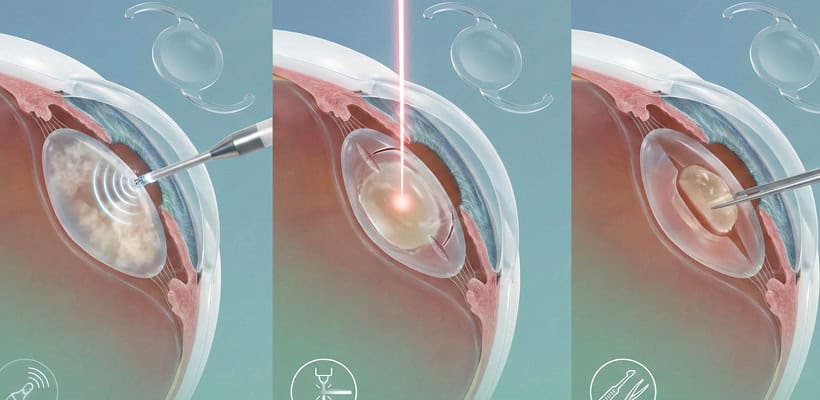



Cataract surgery does more than replace a cloudy natural lens. The artificial intraocular lens (IOL) selected during surgery also influences how comfortably you see at different distances. In India, cataract treatment is a major component of eye care, with over 83 lakh cataract surgeries performed during the financial year 2022-23, according to the Ministry of Health and Family Welfare.
When comparing EDOF vs trifocal lenses, the main consideration is how each lens supports reading, computer work, distance vision, and daily activities. Both offer a wider visual range than standard monofocal lenses, but their optical designs and limitations differ.
At Surya Eye Hospital, cataract treatment includes EDOF, trifocal, and other IOL options. Understanding their differences can help patients discuss suitable lens choices with their ophthalmologist before surgery.
What are EDOF and Trifocal Lenses?
EDOF and trifocal lenses are artificial intraocular lenses designed to provide functional vision across multiple distances after cataract surgery. However, they achieve this through different optical mechanisms.
What Are EDOF Lenses?
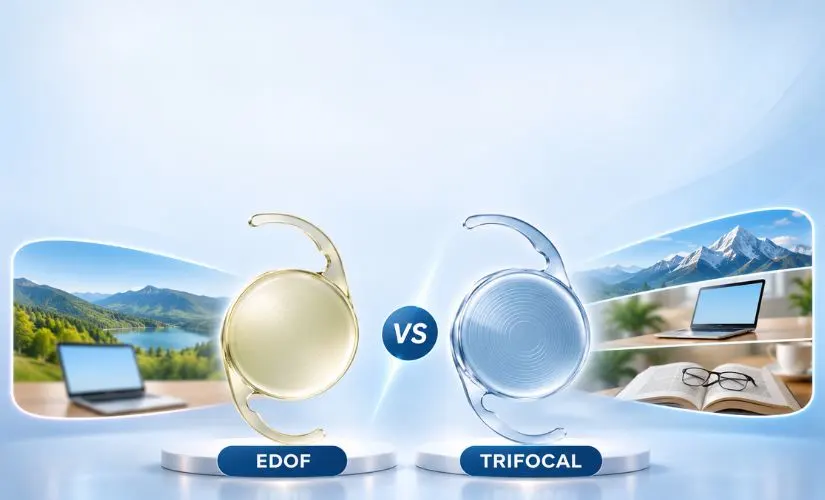
Extended Depth of Focus (EDOF) lenses are designed to extend the range of clear vision rather than produce several distinct focal points. They primarily support distance and intermediate vision, making them suitable for activities such as computer work.
EDOF lenses offer several characteristics:
- Distance vision: Support activities such as watching television and viewing distant objects.
- Intermediate vision: Provide functional vision for computers, dashboards, and kitchen activities.
- Near vision: May support some near tasks, although reading glasses can still be necessary for small print.
- Visual disturbances: Certain EDOF designs may produce fewer halos than trifocal lenses, particularly under low-light conditions.
EDOF technology includes different optical designs, so visual performance and the likelihood of glare can vary between individual lenses.
What Are Trifocal Lenses?
Trifocal lenses are multifocal IOLs designed to provide vision at three principal distances: near, intermediate, and far. Their optical design distributes incoming light between these focal ranges, reducing dependence on spectacles for everyday activities.
Their main characteristics include:
- Near vision: Supports reading books, mobile phone use, and other close-up activities.
- Intermediate vision: Helps with computer work and objects at arm's length.
- Distance vision: Supports outdoor activities, television viewing, and recognising distant objects.
- Spectacle independence: Offers a greater possibility of performing near tasks without glasses compared with many EDOF lenses.
However, distributing light across multiple focal points can produce halos, glare, or reduced contrast sensitivity, particularly in challenging lighting conditions.
EDOF vs Trifocal Lenses: Key Differences
The primary difference between EDOF and trifocal lenses is their visual range. EDOF lenses emphasise continuous distance-to-intermediate vision, while trifocal lenses provide stronger near-vision performance alongside intermediate and distance correction.
| Feature | EDOF Lenses | Trifocal Lenses |
|---|---|---|
| Optical principle | Extended range of focus | Three principal focal points |
| Distance vision | Good | Good |
| Intermediate vision | Good, particularly for screen-based tasks | Good |
| Near vision | Variable; reading glasses may be needed | Generally stronger |
| Reading small print | May require spectacles | Greater potential for spectacle independence |
| Night-time halos | May be less noticeable with certain designs | Can be more noticeable |
| Contrast sensitivity | May be better with some EDOF designs | May be reduced in some lighting conditions |
| Main consideration | Distance and intermediate visual comfort | Wider spectacle independence, especially for near tasks |
These differences represent general clinical patterns rather than guaranteed outcomes. Individual lens models vary considerably, and the condition of the cornea, retina, and ocular surface can influence postoperative vision.
How Do EDOF and Trifocal Lenses Compare in Everyday Activities?
Both lenses can support routine activities after cataract surgery, but their performance differs according to viewing distance and lighting conditions. A patient's occupation, hobbies, reading habits, and night-driving requirements can influence the preferred choice.
Reading and Mobile Phone Use
Trifocal lenses generally provide better unaided near vision than conventional EDOF lenses. They may therefore suit patients who frequently read printed documents, use smartphones, or perform detailed close-up work.
EDOF lenses can still provide functional near vision, particularly with larger text or suitable lighting. However, patients may need reading glasses for fine print, medication labels, or prolonged reading.
Computer Work and Intermediate Vision
EDOF lenses are particularly useful for intermediate-distance activities, including computer work, cooking, and viewing a vehicle dashboard. Their extended focal range can provide comfortable vision across these working distances.
Trifocal lenses also support intermediate vision. However, performance depends on the lens design and the distance between the patient's eyes and the object being viewed.
Night Driving and Low-Light Vision
Some EDOF lenses may provide fewer disturbing halos or better contrast sensitivity than trifocal lenses. This can be relevant for patients who regularly drive after dark. Trifocal lenses may produce rings or halos around headlights and streetlights. Although some patients become less aware of these effects over time, others continue to notice them.
Neither lens eliminates the possibility of glare, and night-driving comfort cannot be guaranteed.
Read More: EDOF and Night Driving: What to Know Before Choosing a Lens
Benefits and Limitations of EDOF and Trifocal Lenses
Both lens categories aim to reduce dependence on spectacles following cataract surgery. Their suitability depends on balancing the desired range of vision against potential optical disturbances.
Benefits and Limitations of EDOF Lenses
EDOF lenses may offer a useful balance between visual range and optical quality, particularly for patients whose activities primarily involve distance and intermediate viewing.
Potential benefits:
- Functional distance and intermediate vision.
- Reduced dependence on glasses for computer work.
- Potentially fewer halos with certain non-diffractive designs.
- A continuous visual range for many routine activities.
Limitations:
- Reading glasses may still be required.
- Fine near-vision tasks can remain challenging.
- Some designs can cause glare or reduced contrast sensitivity.
- Results depend on accurate lens selection and eye health.
Benefits and Limitations of Trifocal Lenses
Trifocal lenses are designed for patients seeking greater independence from glasses across near, intermediate, and distance activities. They can be particularly appealing when reading without spectacles is a major priority.
Potential benefits:
- Improved unaided near vision.
- Functional vision at three principal distances.
- Reduced dependence on reading glasses.
- Greater flexibility for activities requiring frequent changes in viewing distance.
Limitations:
- Halos and glare may affect night-time visual comfort.
- Contrast sensitivity may be reduced.
- Some patients require time to adapt to the visual experience.
- Complete spectacle independence is not guaranteed.
Who is a Suitable Candidate for EDOF or Trifocal Lenses?
EDOF and trifocal lenses may be considered for cataract patients with suitable ocular health and realistic expectations. The final recommendation depends on detailed examination rather than lifestyle preferences alone.
EDOF lenses may be considered for patients who:
- Spend considerable time using computers or digital screens.
- Prioritise distance and intermediate vision.
- Are comfortable using reading glasses occasionally.
- Want to discuss lens options that may reduce night-time visual disturbances.
Trifocal lenses may be considered for patients who:
- Frequently read or perform detailed close-up activities.
- Prefer greater independence from spectacles.
- Need functional vision across multiple distances.
- Understand the possibility of halos and reduced contrast sensitivity.
Patients with significant glaucoma, macular disease, irregular corneas, or other ocular conditions may not be suitable for certain premium IOLs.
Dry eye and astigmatism must also be assessed. Some patients may benefit from toric versions of these lenses, while others may achieve more predictable results with alternative IOL designs.
How is the Right Lens Selected Before Cataract Surgery?
The right IOL is selected through eye measurements, assessment of ocular health, and discussion of the patient's visual expectations. Neither EDOF nor trifocal technology is automatically suitable for every cataract patient.
Preoperative assessment may include:
- Biometry: Measures eye dimensions to calculate the required IOL power.
- Corneal assessment: Evaluates astigmatism and irregularities that may affect visual quality.
- Retinal examination: Identifies macular or retinal conditions that could influence lens suitability.
- Ocular surface evaluation: Checks for dry eye and other conditions that may affect measurements.
- Lifestyle assessment: Reviews reading habits, screen use, occupational needs, and night driving.
Residual refractive errors may still require spectacles or additional correction after surgery. Patients should also discuss their expectations regarding halos, reading distance, and adaptation before selecting a premium IOL.
Conclusion
The choice between EDOF vs trifocal lenses depends primarily on the visual tasks that matter most to the patient. EDOF lenses generally support distance and intermediate vision, while trifocal lenses provide stronger near-vision performance and greater potential freedom from reading glasses.
Both options have limitations, including possible glare, halos, or the continued need for spectacles. The most suitable lens depends on ocular health, eye measurements, lifestyle, and expectations.
At Surya Eye Hospital, patients can undergo cataract evaluation and discuss available IOL options with an ophthalmologist. Individual assessment remains essential before making a final decision.
Frequently Asked Questions (FAQs)
1. Which is better, EDOF or trifocal lenses?
Neither lens is universally better. EDOF lenses may suit patients prioritising computer work and intermediate vision, while trifocal lenses generally provide stronger near vision. The appropriate choice depends on eye health, lifestyle, and tolerance for visual disturbances.
2. Do EDOF lenses eliminate the need for reading glasses?
EDOF lenses can reduce dependence on spectacles for several daily activities, particularly at intermediate distances. However, patients may still need reading glasses for small print, detailed close-up work, or prolonged reading, depending on their lens design.
3. Are trifocal lenses suitable for night driving?
Trifocal lenses can provide functional distance vision for driving, but some patients experience halos or glare around headlights. These effects may become less noticeable with adaptation, although persistent disturbances can affect night-driving comfort in certain individuals.
4. Can EDOF lenses correct astigmatism?
Certain EDOF lenses are available in toric designs that correct regular corneal astigmatism during cataract surgery. Suitability depends on corneal measurements, astigmatism severity, and eye health. An ophthalmologist can determine whether a toric EDOF lens is appropriate.
5. How long does it take to adjust to trifocal lenses?
Adaptation to trifocal lenses varies between patients. Some become comfortable with their new vision within weeks, while others require longer. Temporary visual disturbances may improve, but persistent glare, blurred vision, or discomfort should be assessed by an ophthalmologist.
6. Can EDOF and trifocal lenses be implanted in different eyes?
An EDOF lens in one eye and a trifocal lens in the other may be considered for selected patients. This approach requires careful planning because differences in visual performance can affect comfort, binocular vision, and adaptation.
Get expert guidance on lens choices, surgery planning and the approach suited to your vision needs.